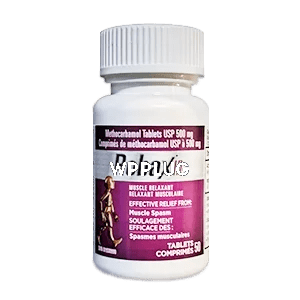
Robaxin
| Product dosage: 500mg | |||
|---|---|---|---|
| Package (num) | Per pill | Price | Buy |
| 10 | $4.00 | $40.00 (0%) | 🛒 Add to cart |
| 20 | $2.25 | $80.00 $45.00 (44%) | 🛒 Add to cart |
| 30 | $1.67 | $120.00 $50.00 (58%) | 🛒 Add to cart |
| 60 | $0.92 | $240.00 $55.00 (77%) | 🛒 Add to cart |
| 90 | $0.67 | $360.00 $60.00 (83%) | 🛒 Add to cart |
| 120 | $0.58 | $480.00 $70.00 (85%) | 🛒 Add to cart |
| 180 | $0.50 | $720.00 $90.00 (88%) | 🛒 Add to cart |
| 270 | $0.44 | $1080.00 $120.00 (89%) | 🛒 Add to cart |
| 360 | $0.42
Best per pill | $1440.00 $150.00 (90%) | 🛒 Add to cart |
Synonyms | |||
Robaxin: Targeted Muscle Relaxation for Acute Musculoskeletal Pain
Robaxin (methocarbamol) is a centrally acting skeletal muscle relaxant indicated for the relief of discomfort associated with acute, painful musculoskeletal conditions. It is used as an adjunct to rest, physical therapy, and other measures for the relief of muscle spasm. The medication works by blocking nerve impulses (or pain sensations) that are sent to the brain, helping to break the cycle of pain-spasm-pain. It is not a controlled substance and is available by prescription only, offering a non-narcotic option for managing acute muscular pain.
Features
- Active Ingredient: Methocarbamol
- Available in 500 mg and 750 mg oral tablets
- Also available in injectable form for hospital use
- Onset of action is relatively rapid
- Not classified as a controlled substance
- Often used as part of a comprehensive treatment plan
Benefits
- Effectively reduces muscle spasms and associated pain, improving mobility.
- Provides a non-narcotic, non-addictive option for acute musculoskeletal pain management.
- Helps break the cycle of pain and spasm, facilitating participation in physical therapy.
- Can contribute to a faster return to normal daily activities when used as part of a full treatment regimen.
- Offers flexibility with oral and injectable formulations for different clinical settings.
Common use
Robaxin is commonly prescribed for the relief of discomfort associated with acute, painful musculoskeletal conditions. Its primary use is as an adjunct to rest and physical therapy. Typical conditions it is prescribed for include lower back pain, muscle strains, sprains, and tetanus. It is specifically intended for short-term use to manage acute episodes rather than for chronic pain conditions.
Dosage and direction
Adults and children 16 years and older: The initial recommended dosage is 1500 mg (two 750 mg tablets or three 500 mg tablets) four times a day for the first 48 to 72 hours of treatment. For severe conditions, a dosage of 8 grams per day may be administered under medical supervision. Maintenance dosage: After the first 48 to 72 hours, the dosage can often be reduced to approximately 4 to 4.5 grams daily, divided into three or four doses (e.g., one 1500 mg dose three times a day or two 750 mg tablets three times a day). The dosage for children under 16 years of age has not been established. The tablets should be taken orally, with or without food. The injectable form is for intramuscular or intravenous use only and must be administered by a healthcare professional.
Precautions
- Use with caution in patients with renal impairment, as the drug is excreted by the kidneys.
- May cause drowsiness or dizziness. Patients should be cautioned about operating machinery, driving, or engaging in activities requiring mental alertness until they know how the drug affects them.
- The sedative effects of Robaxin may be potentiated by alcohol, sedatives, hypnotics, or other CNS depressants.
- Safety and efficacy in pediatric patients have not been established.
- Use during pregnancy only if the potential benefit justifies the potential risk to the fetus.
- Caution is advised in patients with a history of seizure disorders, as methocarbamol may lower the seizure threshold.
- The injectable formulation may cause hemolysis and hemoglobinuria, especially with rapid IV administration.
Contraindications
Robaxin is contraindicated in patients with a known hypersensitivity to methocarbamol or any component of the formulation. The injectable form is also contraindicated in patients with renal impairment or a history of seizures, due to the propylene glycol solvent.
Possible side effect
The most frequently reported side effects are dose-related and often CNS-related. These include:
- Dizziness
- Drowsiness
- Lightheadedness
- Nausea
- Vomiting
- Blurred vision or diplopia (double vision)
- Headache
- Rash
- Fever Less common but more serious side effects can include:
- Allergic reactions (e.g., urticaria, pruritus, rash, angioedema, anaphylaxis)
- Leukopenia
- Seizures
- Jaundice (hepatic dysfunction)
- Syncope (fainting)
- Bradycardia
Drug interaction
Robaxin can potentiate the effects of other CNS depressants, leading to increased sedation, dizziness, and impaired mental and physical abilities. Concomitant use with the following requires extreme caution and possibly dosage adjustment:
- Alcohol
- Benzodiazepines (e.g., alprazolam, diazepam)
- Opioid analgesics (e.g., hydrocodone, oxycodone)
- Sedating antihistamines
- Barbiturates
- Other skeletal muscle relaxants
- Certain antidepressants and antipsychotics Methocarbamol may cause false-positive readings for 5-hydroxyindoleacetic acid (5-HIAA) and vanillylmandelic acid (VMA) in certain qualitative tests.
Missed dose
If a dose is missed, it should be taken as soon as it is remembered. However, if it is almost time for the next scheduled dose, the missed dose should be skipped. Do not double the dose to make up for a missed one.
Overdose
Symptoms of a Robaxin overdose are primarily an extension of its side effects and may include severe nausea, vomiting, drowsiness, blurred vision, syncope (fainting), coma, and seizures. Treatment is primarily supportive and symptomatic. Management includes gastric lavage or activated charcoal (if ingestion was recent and the patient is alert), monitoring of vital signs, and support of respiratory and cardiovascular functions. There is no specific antidote. Seizures may be treated with benzodiazepines.
Storage
Store Robaxin tablets at room temperature, between 20°C to 25°C (68°F to 77°F). Excursions are permitted between 15°C to 30°C (59°F to 86°F). Keep the medication in its original container, tightly closed, and out of reach of children and pets. Do not store in damp or humid places, such as bathrooms. Safely discard any expired or unused medication.
Disclaimer
This information is for educational purposes only and is not a substitute for professional medical advice, diagnosis, or treatment. Always seek the advice of your physician or other qualified health provider with any questions you may have regarding a medical condition or before starting any new treatment. Never disregard professional medical advice or delay in seeking it because of something you have read here. The information provided may not cover all possible uses, directions, precautions, drug interactions, or adverse effects.
Reviews
- “As a physical therapist, I often see patients who are prescribed Robaxin for acute low back spasms. When combined with our therapy protocols, it appears to be effective in reducing pain enough for patients to engage more fully in their exercises, which is crucial for recovery.” – Medical Professional
- “Prescribed this after a significant muscle strain. It made me quite drowsy for the first few days, but it definitely took the edge off the severe muscle spasms. The drowsiness subsided as my body adjusted and the dosage was lowered.” – Patient
- “I appreciate having a non-narcotic option to offer patients for acute musculoskeletal pain. It’s a useful tool in the toolkit, especially for those who need to avoid opioids.” – Orthopedic Specialist
- “It worked well for my neck spasm, but the dizziness was noticeable. I had to be very careful getting up from a seated position. It was effective for the short-term relief I needed.” – Patient